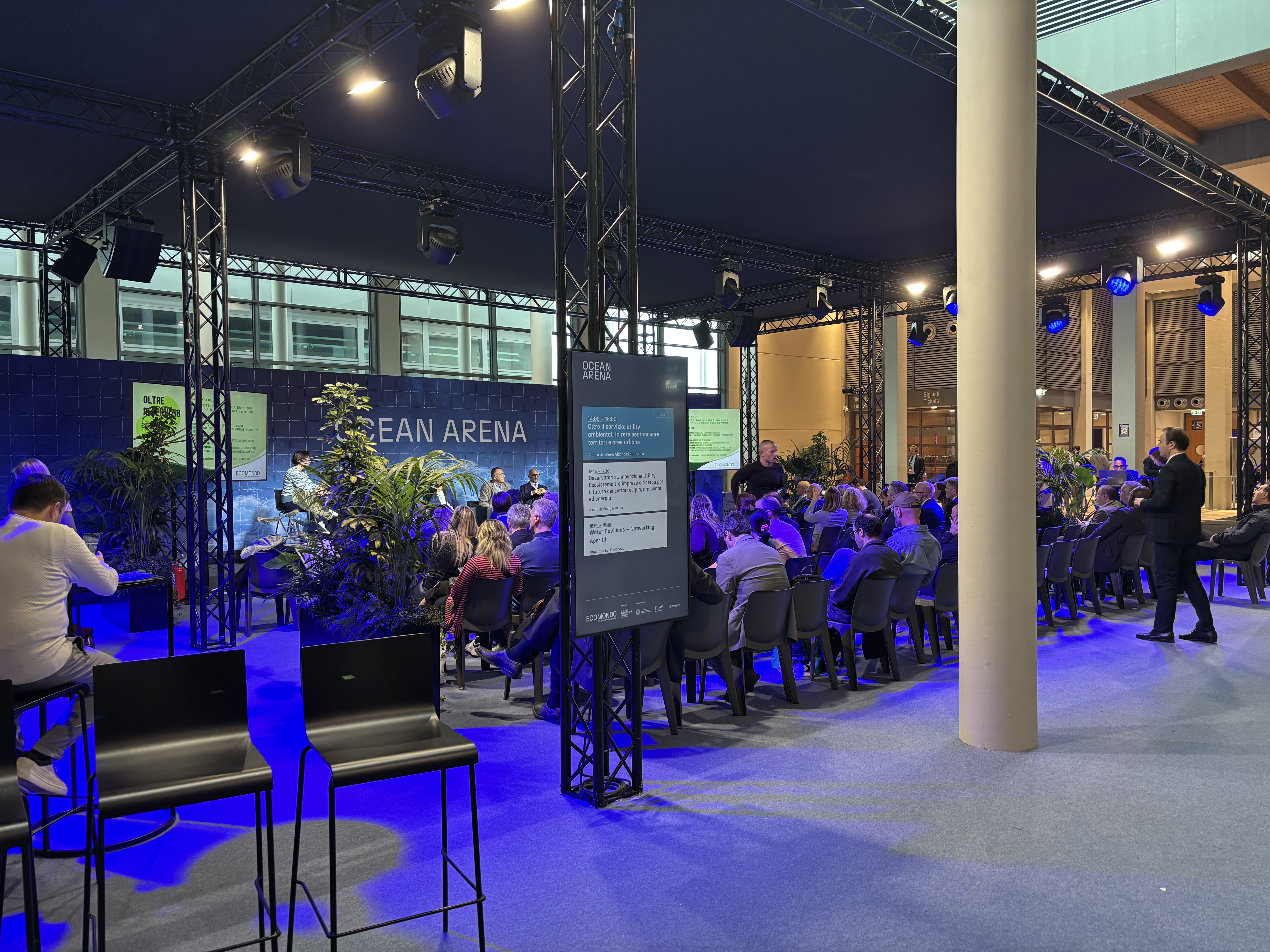
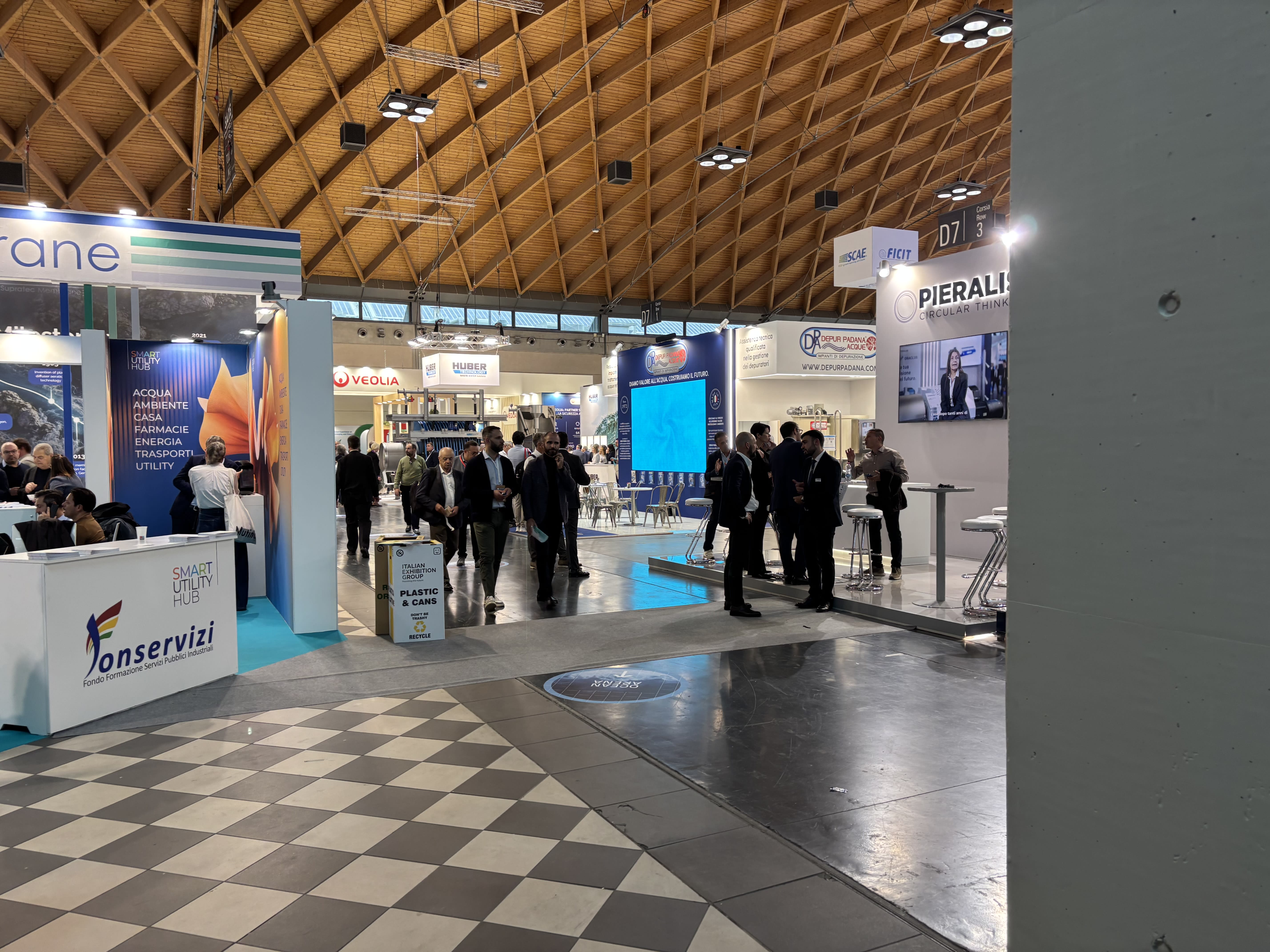
I spent a few days at Ecomondo in Rimini this year, between the conference rooms and the exhibition halls. I came back with three impressions. Italy has made real progress digitalizing its water networks. The industry is now racing to put AI on top of that data. And the security of all those new connections is getting far less attention than it should.
Here is what I saw, split into three parts: where Italy stands, what caught my eye on the show floor, and where I think HMS fits.
The water infrastructure session brought together three perspectives: the Ministry of Infrastructure and Transport (MIT), Utilitalia, the federation of Italian utilities, and Acea, one of the country’s largest water operators. Together they gave a clear picture of a sector that has invested heavily and is now asking what that investment is really delivering.
PNRR delivered the kilometres
Much of the recent progress comes from the PNRR, Italy’s recovery plan. Its investment line on reducing losses in drinking water networks, including digitalization and monitoring, funded 101 projects worth €1.89 billion. One more project, worth €17 million, lost its funding because work never started.
The targets were ambitious: at least 14,000 km of network divided into districts by the end of 2024, and at least 45,000 km by the end of 2025. According to MIT, by the end of 2025 around 50,000 km of drinking water pipeline had been equipped with new instruments and control systems to locate and reduce leaks.
The work itself followed a familiar recipe. Utilities mapped their networks in GIS, installed smart instruments for flow, pressure, tank levels and water quality, built hydraulic models, fitted pressure control valves, and divided their networks into districts for active leakage control. MIT summed up the approach as “divide and conquer”: split a big problem into smaller ones that are easier to manage.
The loss figures are not in yet
What the kilometres have achieved is less clear. The utilities funded by this programme consume about 2.4 billion cubic metres of water a year, roughly 25% of Italy’s total drinking water consumption of around 9.5 billion. Over the last regulatory period, they declared about 1 billion cubic metres of losses.
Over the last four years, 42 of these utilities reduced their losses and 43 reported higher ones. MIT explained that some increases come from utilities taking over more network, or from measuring differently once their networks are digitalized. In other words, better measurement can make things look worse before they look better. MIT says it needs at least another year before the figures are final.
I found that honest, and important. Digitalization doesn’t just fix problems. It also reveals ones that were always there.
The money is getting tighter
PNRR is coming to an end, and the national plan that follows is under pressure. Italy’s National Plan for Water Infrastructure and Security (PNIISSI), adopted in October 2024, received 521 proposals in its first round. Of those, 418 entered the plan, requesting about €12 billion. So far, 75 projects worth about €1 billion are programmed in the 2025 tranche, 59 projects worth about €1.58 billion through a separate fund, and a further €0.7 billion is being assigned for 2026.
Demand keeps growing. MIT’s latest call, which closed in April 2026, received 581 proposals with a total need of €18.4 billion.
Utilitalia was direct about what this means: not everything can be paid for through tariffs, and the sector will need a new way to finance investment once PNRR ends. Digital projects will have to compete for that money with pipes, treatment plants and drought infrastructure.
A sector moving at two speeds
Utilitalia presented its Water Smart Utility Report, based on a survey of its members. The sample covers 26 water supply utilities serving 24.6 million people, 20 sewerage utilities serving 14 million, and 19 treatment utilities serving 13 million. It compares 2023 with 2025, and the picture is one of fast progress in networks and slower progress in plants.
On the water supply side, the share of network managed from a control room rose from 49% to 76% in two years. Pressure-monitored network went from 35% to 58%, districted network from 38% to 54%, and remotely read customers from 15% to 34%. Network with leak detection jumped from 1% to 13%.
Plants are a different story. Telecontrolled drinking water treatment plants only moved from 28% to 32%, and those with decision support from 9% to 14%.
Wastewater shows a similar gap. Telecontrol covers 96.5% of treated volume, but only 39.8% of treatment plants. In other words, the large plants are connected, while a long tail of smaller sites is not. Telecontrolled lift stations rose from 57.3% to 65.1%, and only 17.1% of the sewer network has measured flow.
Utilitalia’s conclusions were clear. Digitalization is now a pillar of the water service, and PNRR accelerated the change. Smart metering, telecontrol and AI make management more predictive. But the benefits depend on the physical state of the infrastructure, and after PNRR, skills, data interoperability and cybersecurity will decide whether the transformation lasts.
Acea: data is only worth something when it changes a decision
The most thought-provoking talk came from Alberto Trotta of Acea. His message was simple: digitalization is not the finish line. The point is not to digitalize to get more data, but to digitalize to manage better. An intelligent network does not produce more information. It produces better choices.
He then proposed some reference points for a healthy investment plan. Between 8% and 12% should go to digitalization, from smart meters and district metering to pressure management, sensors, telecontrol and predictive tools. Unplanned maintenance that ends up capitalized should stay at or below 8–9%. At least 40% of investment should have quantifiable benefits, and at least 80% of the portfolio should be covered by KPIs measured after the fact, in cubic metres, kWh, OPEX, failures, service interruptions, asset life and risk. His condition was strict: technology only creates value if it reduces water loss, energy, failures, OPEX or risk.
Acea showed how it applies this across the whole water cycle, from forecasting water availability at the source to district metering, smart metering and process automation in wastewater treatment. The clearest example is Minerva, Acea’s decision support system for its primary network. It forecasts consumption by pressure zone, combines it with real-time measurements, recalculates optimized control strategies every 30 minutes, checks them against a real-time hydraulic model, and then proposes or sends commands and set-points to pumps and valves through SCADA.
His closing line stayed with me: the network of the future is not digital, it is digitally governed. Digital tools don’t replace industrial responsibility. They make it better informed, faster and more transparent.
AI has moved into the platforms
Compared with previous editions of Ecomondo, the biggest change I noticed was the growing use of AI and machine learning inside cloud platforms. Not long ago, most water stands were still talking about dashboards and connectivity. This year, more of the conversation was about what the platform does with the data once it arrives.
The goals were similar across very different companies. They want to predict failures on pumps, blowers and membranes, so maintenance can be planned instead of reactive. They want to cut energy and chemical use, especially in pumping and aeration, where savings show up quickly. They want to spot leaks and process anomalies earlier, by learning what normal behaviour looks like in each district or plant. And they want to give operators recommendations, rather than one more screen to watch.
Several companies I follow in water IIoT reflected this shift. Xylem, with Xylem Vue, is focused on decision intelligence for utilities. Veolia keeps building on Hubgrade, combining remote monitoring, AI and its own operating expertise. Aquanexa, now part of Acea Group, is bringing network services and smart metering data together on one platform. Almaviva stood out for combining network monitoring with a strong cybersecurity offer. Gruppo Sostelia, now part of Hera, brings its experience operating treatment plants. Supratec is applying monitoring to membranes, and Greeneco presented a new platform that uses machine learning for prediction.
It’s a healthy sign. The sector has moved from asking whether it can see its assets to asking whether software can help decide what to do with them.
Cybersecurity stayed in the background
What I didn’t see was much focus on cybersecurity. Apart from a few exceptions, such as Almaviva, few exhibitors showed security solutions or even mentioned the topic. That surprised me.
The regulation is already here. Italy has transposed the NIS2 directive, and both drinking water and wastewater are within its scope. For the first group of companies registered, the deadline to have basic security measures in place passed in October 2026. On the product side, the main obligations of the EU Cyber Resilience Act will apply from December 2027, so every device with digital components sold into a water plant will have to be secure by design.
Every platform I saw depends on field data reaching the cloud reliably, and on commands coming back safely. The more intelligence moves into the platform, the more critical the OT layer underneath becomes. A system that can send set-points to pumps and valves is only as trustworthy as the network that carries them.
Secure connectivity is the precondition for everything else on show at Ecomondo. It deserves more attention than it got.
Many of the system integrators and machine builders working in water already use Ewon to connect their plants and skids, including IWE and Veolia, among many others. IWE, which builds vacuum evaporators for industrial wastewater, uses Ewon Cosy+ and Talk2M to support its machines remotely. In its case study, it reports annual savings of around €218,000 in travel and €302,000 in operating costs, plus 6,300 hours of technicians’ time.
The conversations that encouraged me most, though, were about cybersecurity. Several companies came to us looking for more than a connectivity device. They wanted a partner to help them develop secure products and secure architectures, ready for NIS2 today and the Cyber Resilience Act tomorrow.
That is where HMS can bring more than hardware. Our Professional Services team works with integrators, machine builders and utilities to design those architectures, and our cybersecurity solutions cover the layers these regulations focus on, starting with secure remote access through Talk2M, which is certified to ISO 27001.
I left Rimini very satisfied. Smart water and cybersecurity are both growing fast within industrial communications, the area where HMS shines. Ecomondo confirmed that the demand is real. AI will keep getting the headlines, but the companies building these platforms know they first need reliable, secure data from the field.
That is exactly what we do.